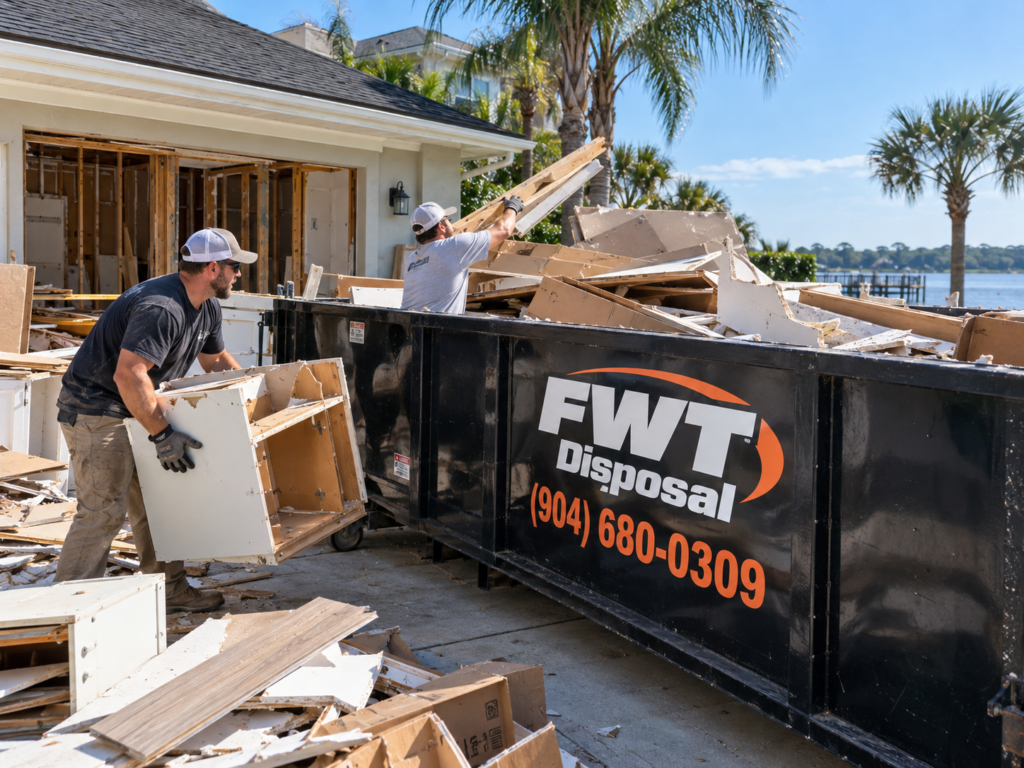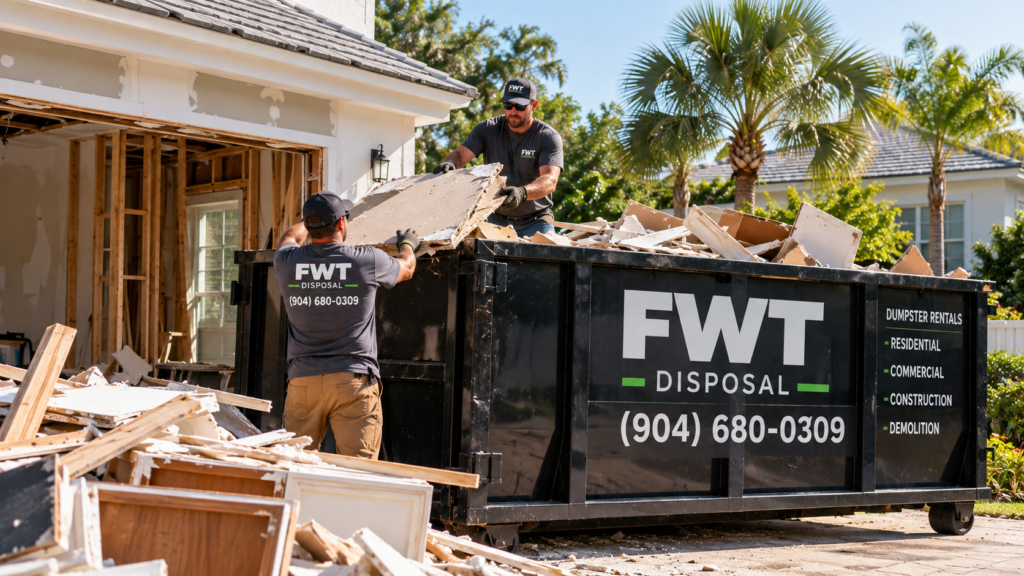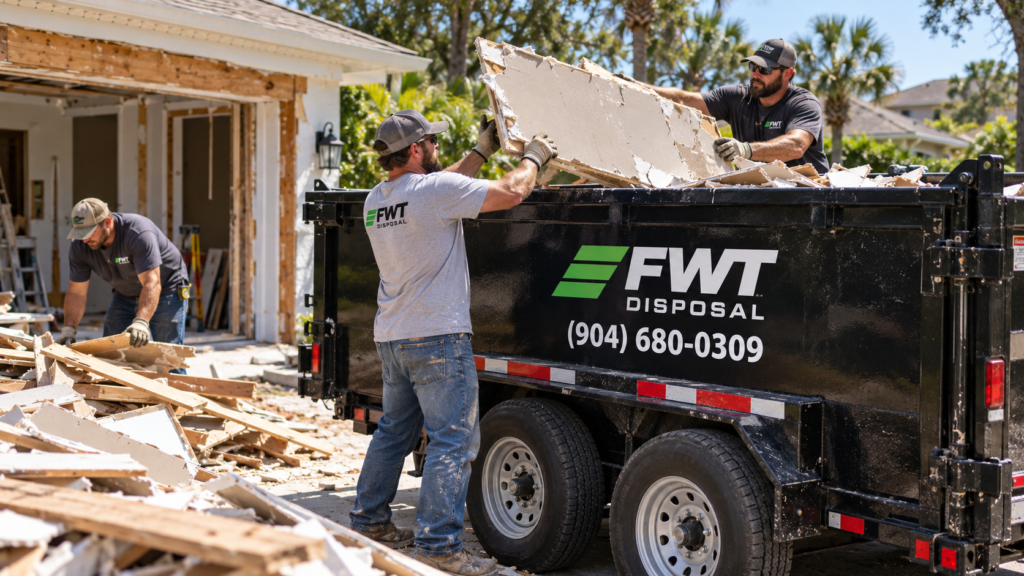
Choosing the right dumpster size for construction debris can save time, money, and frustration during a renovation, demolition, roofing job, or construction project.
Choose a dumpster that is too small and you may need an additional pickup or second container.
Choose one that is much larger than necessary and you may pay for capacity you never use.
The challenge is that construction debris varies dramatically.
A bathroom remodel may generate drywall, tile, cabinets, flooring, and fixtures. A driveway removal may generate mostly concrete. A roofing project may create thousands of pounds of shingles. A whole-house renovation can produce a mixture of lumber, drywall, flooring, cabinetry, and demolition debris.
That means the right dumpster size for construction debris depends on more than the physical size of the project.
You also need to consider:
- The type of debris
- Total volume
- Material weight
- Length of the project
- Available dumpster placement space
- Whether debris will be mixed or separated
FWT Disposal offers 10, 15, 20, 30, and 40-yard roll-off dumpsters for projects throughout Northeast Florida, giving homeowners and contractors several options depending on the job.
This guide will help you understand which dumpster size may fit your construction project.
Why Dumpster Size Matters for Construction Debris
Construction projects can produce debris surprisingly quickly.
During demolition, materials that once occupied relatively little visible space inside a building become loose, bulky waste.
A kitchen cabinet that fits neatly against a wall becomes several large pieces after demolition.
Drywall sheets break into irregular sections.
Lumber, trim, flooring, tile, insulation, packaging, and fixtures all begin taking up space.
Choosing the right dumpster size for construction debris gives the project enough disposal capacity without unnecessarily oversizing the container.
The goal is to balance three things:
Volume
How much physical space will the debris occupy?
Weight
How heavy will the materials become once loaded?
Project type
What kind of work is producing the debris?
These three factors are more useful than simply asking, “How big is the house?”
Understanding Dumpster Sizes
Roll-off dumpsters are typically measured in cubic yards.
A 10-yard dumpster can hold approximately 10 cubic yards of material.
A 20-yard dumpster provides approximately twice that volume.
The same principle applies to larger containers.
However, cubic-yard capacity does not mean you can fill every dumpster completely with any material.
Heavy debris can reach transportation weight limits before the container is physically full.
That distinction is especially important when choosing a dumpster size for construction debris involving:
- Concrete
- Brick
- Asphalt
- Masonry
- Dirt
- Roofing shingles
For lighter construction materials such as drywall, wood, cabinets, and packaging, volume tends to become the bigger concern.
Quick Construction Dumpster Size Guide
Here is a simple starting point:
| Dumpster Size | Best For | Example Projects |
|---|---|---|
| 10 Yard | Small renovations and heavy debris | Small bathroom remodel, flooring, patio removal, concrete |
| 15 Yard | Small-to-medium remodeling | Kitchen updates, flooring, deck removal |
| 20 Yard | Medium renovations | Kitchen remodel, multiple rooms, larger cleanouts |
| 30 Yard | Large construction projects | Major remodel, home addition, larger demolition |
| 40 Yard | Large-volume construction | Commercial construction, major demolition, large renovation |
This table is only a starting point.
Material weight and project details should always be considered before selecting the final dumpster size for construction debris.
10-Yard Dumpster for Construction Debris
A 10-yard dumpster is one of the smallest standard roll-off options, but it can be extremely useful for construction projects.
Smaller does not mean less useful.
In fact, a 10-yard dumpster can be the right choice when the project produces a concentrated amount of debris or when heavy materials are involved.
Good Projects for a 10-Yard Dumpster
A 10-yard construction dumpster may work well for:
- Small bathroom renovation
- Flooring removal
- Small kitchen demolition
- Small deck removal
- Shed demolition
- Patio removal
- Concrete projects
- Brick or masonry projects
- Small roofing repairs
- Minor construction cleanup
A 10-yard dumpster can also be easier to place on residential properties where driveway space is limited.
10-Yard Dumpster for Concrete
Concrete deserves special consideration.
Because concrete is extremely dense, you usually do not want to choose a huge dumpster simply because more volume is available.
The container can reach its weight allowance long before it appears full.
If your project involves concrete, read our guide to Concrete Disposal Near Me in Northeast Florida before choosing your container.
15-Yard Dumpster for Construction Debris
A 15-yard dumpster offers more capacity than a 10-yard container without jumping directly to a larger 20-yard option.
This makes it useful for many residential renovation projects.
Good Projects for a 15-Yard Dumpster
Consider a 15-yard dumpster for:
- Medium bathroom renovation
- Small kitchen remodel
- Flooring replacement
- Deck removal
- Garage renovation
- Interior demolition
- Small home improvement projects
- Residential construction debris
The 15-yard option can be particularly useful when a 10-yard dumpster feels too small but a 20-yard container may provide more space than the project needs.
For many homeowners, this is a practical middle-ground dumpster size for construction debris.
20-Yard Dumpster for Construction Debris
A 20-yard dumpster is one of the most versatile sizes for residential construction and renovation projects.
It provides substantially more capacity than smaller containers while remaining practical for many driveways and residential properties.
FWT currently describes its 20-yard dumpster as suitable for renovations and larger cleanouts.
Good Projects for a 20-Yard Dumpster
A 20-yard construction dumpster may work well for:
- Kitchen renovation
- Multiple-room remodel
- Flooring replacement throughout a home
- Deck demolition
- Garage cleanout plus renovation
- Medium roofing project
- Residential construction
- Home improvement projects
- Interior demolition
- Larger landscaping projects
For many homeowners asking what size dumpster do I need, the 20-yard option is often worth considering because it provides flexibility without automatically moving to a contractor-sized container.
30-Yard Dumpster for Construction Debris
Once a project moves beyond a typical room renovation, a 30-yard dumpster becomes increasingly useful.
FWT identifies its 30-yard dumpster as suited for construction and major remodels.
This container provides much more volume for bulky construction materials.
Good Projects for a 30-Yard Dumpster
A 30-yard dumpster may be appropriate for:
- Whole-house renovation
- Large remodeling project
- Home addition
- Larger roofing job
- Commercial renovation
- Property rehabilitation
- Large interior demolition
- Contractor jobsite cleanup
- New construction
- Multi-room renovation
A 30-yard construction dumpster can also make sense when the debris consists mostly of bulky but relatively lighter materials such as:
- Drywall
- Lumber
- Cabinets
- Siding
- Insulation
- Flooring
- Packaging
For many contractors, this dumpster size for construction debris provides a useful balance between large capacity and manageable placement.
40-Yard Dumpster for Construction Debris
A 40-yard dumpster offers the largest standard capacity in FWT’s current lineup.
FWT positions this size for large commercial and demolition projects.
A 40-yard container is designed for projects producing a large amount of debris.
Good Projects for a 40-Yard Dumpster
A 40-yard construction dumpster may work well for:
- Large commercial renovation
- Major demolition
- Large construction projects
- Commercial property improvement
- Large building cleanout
- Major home renovation
- High-volume contractor work
However, a 40-yard dumpster is not automatically appropriate just because a project is large.
Heavy materials can still become the limiting factor.
Filling a 40-yard container with dense concrete or masonry may exceed weight limitations long before the container is full.
For heavy debris, always discuss the material with FWT before choosing the dumpster size for construction debris.
What Size Dumpster Do I Need for a Bathroom Remodel?
Bathroom remodels vary significantly.
A simple cosmetic renovation may only produce:
- Vanity
- Flooring
- Small fixtures
- Packaging
A full bathroom demolition may include:
- Tile
- Drywall
- Shower surround
- Bathtub
- Vanity
- Flooring
- Fixtures
- Lumber
- Cement board
For a smaller bathroom project, a 10-yard dumpster may provide enough space.
A larger bathroom remodel involving significant demolition may justify a 15-yard container.
The amount of tile and masonry should also be considered because those materials add weight quickly.
What Size Dumpster Do I Need for a Kitchen Remodel?
Kitchen renovations often generate more debris than homeowners expect.
You may remove:
- Cabinets
- Countertops
- Drywall
- Flooring
- Appliances
- Fixtures
- Tile
- Packaging
A smaller kitchen remodel may fit into a 15-yard dumpster.
A full kitchen renovation may be better suited to a 20-yard dumpster, particularly when cabinets, flooring, drywall, and other bulky materials are all being removed.
For a kitchen remodel that is part of a larger home renovation, a 30-yard container may make more sense.
What Size Dumpster Do I Need for a Whole-House Renovation?
Whole-home renovations produce debris from several rooms and often continue over multiple stages.
Materials can include:
- Drywall
- Flooring
- Cabinets
- Doors
- Trim
- Lumber
- Fixtures
- Tile
- Siding
- Packaging
A 30-yard dumpster is often worth considering for substantial residential renovation.
A 40-yard dumpster may be appropriate for larger projects with high debris volume.
However, project sequencing matters.
Some contractors prefer one larger dumpster.
Others may prefer smaller containers with scheduled pickups as demolition progresses.
Choosing the best dumpster size for construction debris should account for how quickly debris will be generated.
What Size Dumpster Do I Need for Demolition?
Demolition projects require extra planning because the debris type can vary dramatically.
Demolishing a wood shed is very different from demolishing a concrete structure.
Small Demolition
Examples:
- Shed
- Small deck
- Interior wall
- Small outbuilding
A 10- or 15-yard dumpster may work.
Medium Demolition
Examples:
- Large deck
- Garage interior
- Multiple rooms
- Small structure
A 20- or 30-yard dumpster may be more appropriate.
Large Demolition
Examples:
- Major building interior
- Commercial structure
- Large residential demolition
A 30- or 40-yard container may be required.
The material composition is just as important as the structure size.
Concrete, masonry, and heavy roofing materials may require a different plan than wood-framed demolition.
What Size Dumpster Do I Need for Roofing?
Roofing debris can be deceptively heavy.
Asphalt shingles create a dense load.
The correct dumpster depends on:
- Roof size
- Number of roofing layers
- Type of shingles
- Additional decking removal
- Weight allowance
A 20-yard dumpster may work for many residential roofing projects, but larger roofs can require greater capacity.
Do not select the container based only on how much space the shingles appear to occupy.
Weight should be part of the decision.
What Size Dumpster Do I Need for a Deck Removal?
Deck demolition usually creates bulky wood debris.
Small decks may fit into a 10- or 15-yard container.
Medium and larger decks may justify a 20-yard dumpster.
If concrete footings or masonry are also being removed, mention those materials before ordering because they significantly increase weight.
What Size Dumpster Do I Need for Flooring Removal?
Flooring projects vary depending on the material.
Lighter Flooring
- Carpet
- Vinyl
- Laminate
These materials primarily consume volume.
Heavier Flooring
- Ceramic tile
- Stone
- Thick hardwood
- Mortar
- Cement board
These materials can significantly increase weight.
A 10- or 15-yard dumpster may work for smaller flooring projects.
Whole-house flooring replacement may require a 20-yard container or larger depending on the materials.
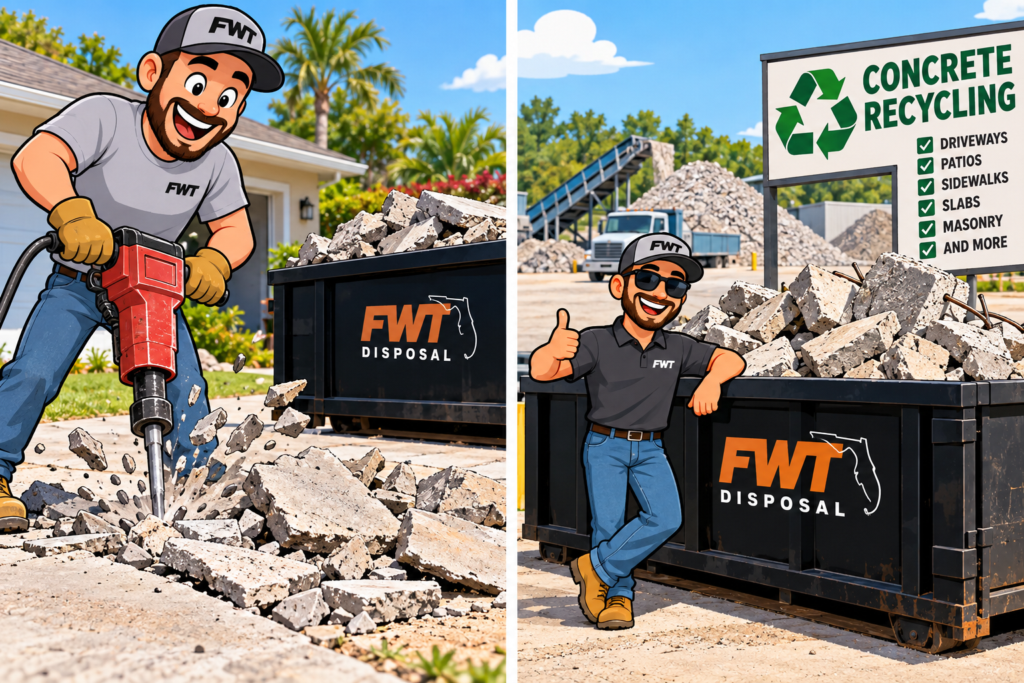
What Size Dumpster Do I Need for Concrete?
Concrete is one of the most important exceptions to normal dumpster sizing.
Do not choose the largest possible dumpster and fill it with concrete.
Concrete can weigh thousands of pounds while occupying relatively little space.
For smaller concrete projects, a 10-yard container may be more appropriate than a large construction dumpster.
Examples include:
- Patio removal
- Sidewalk removal
- Small driveway sections
- Concrete slab removal
- Masonry demolition
If the project is primarily concrete, tell FWT before ordering.
Our Concrete Disposal Near Me in Northeast Florida guide explains this in more detail.
Heavy Debris vs. Bulky Debris
Understanding the difference between heavy and bulky materials makes choosing a dumpster size for construction debris much easier.
Bulky but Relatively Light Debris
Examples:
- Cabinets
- Drywall
- Lumber
- Doors
- Siding
- Insulation
- Packaging
With these materials, volume often becomes the biggest issue.
Larger containers can be beneficial.
Dense, Heavy Debris
Examples:
- Concrete
- Brick
- Asphalt
- Masonry
- Tile
- Dirt
- Roofing shingles
With these materials, weight may become the limiting factor before volume.
This distinction is critical when selecting the container.
Don’t Choose Dumpster Size Based Only on Square Footage
It can be tempting to use the size of the house as the main calculation.
For example:
“My house is 2,000 square feet, so what dumpster do I need?”
Unfortunately, that does not tell us enough.
A 2,000-square-foot flooring replacement generates very different debris from a 2,000-square-foot full interior demolition.
Instead, consider:
Scope of work
What is actually being removed?
Material
Drywall? Concrete? Tile? Lumber?
Depth of demolition
Cosmetic renovation or full gut?
Number of rooms
One bathroom or the entire house?
Project duration
Will debris be generated over one weekend or several weeks?
These factors provide a much better estimate.
Can I Save Money by Choosing a Smaller Dumpster?
Sometimes—but not always.
Choosing a smaller dumpster may reduce the initial rental price.
But if the container fills before the project is finished, you may need:
- Another dumpster
- Additional pickup
- Swap-out service
- More hauling
That can make the overall project more expensive.
The goal should not simply be to choose the cheapest dumpster.
The goal is to choose the most appropriate dumpster size for construction debris.
A properly sized container can reduce interruptions and keep the project moving.
Is a Bigger Dumpster Always Better?
No.
A larger dumpster provides more volume, but that does not automatically make it better.
Reasons not to automatically choose the largest dumpster include:
- Limited driveway or jobsite space
- Heavy debris restrictions
- Unused capacity
- Higher rental cost
- Difficulty positioning the container
A well-matched 20-yard dumpster can be more useful than an unnecessarily large 40-yard container.
How Much Construction Debris Will My Project Generate?
Estimating debris volume does not need to be perfect.
Start by listing what will be removed.
For example:
Bathroom Remodel
- Vanity
- Bathtub
- Tile
- Drywall
- Flooring
Kitchen Remodel
- Cabinets
- Countertops
- Flooring
- Drywall
- Fixtures
Whole-House Renovation
- Flooring
- Drywall
- Cabinets
- Doors
- Trim
- Fixtures
- Lumber
The more specific you are when speaking with the dumpster provider, the easier it becomes to recommend an appropriate size.
Consider the Type of Construction Material
The U.S. Environmental Protection Agency identifies common construction and demolition materials including concrete, wood, asphalt, gypsum drywall, metals, bricks, glass, plastics, and salvaged building components.
These materials do not behave the same way inside a dumpster.
Wood and drywall primarily consume volume.
Concrete and brick quickly consume weight capacity.
Knowing the waste stream before ordering helps avoid choosing the wrong container.
Consider Dumpster Placement Space
The ideal dumpster size for construction debris also needs to physically fit at the project location.
Before delivery, consider:
- Driveway width
- Driveway length
- Gates
- Trees
- Utility lines
- Vehicles
- Buildings
- Turning space
- Access for pickup
A contractor may have plenty of space at a commercial jobsite.
A homeowner may need to fit the container onto a residential driveway.
Choosing a dumpster that works for the project but cannot be conveniently placed creates a new problem.
Construction Dumpster Sizes for Contractors
Contractors often need more than simple volume estimates.
A contractor should consider:
- Demolition schedule
- Number of trades
- Waste generation rate
- Jobsite space
- Debris type
- Pickup schedule
- Whether multiple containers are required
For recurring contractor work, using several standard dumpster sizes based on typical project types can simplify planning.
For example:
Small renovation → 15 yard
Medium remodel → 20 yard
Major remodel → 30 yard
Large construction → 40 yard
Heavy debris projects should still be considered separately.
Construction Dumpster Sizes for Homeowners
Homeowners usually have fewer projects to compare against, making it harder to visualize dumpster sizes.
The easiest approach is to describe the project rather than trying to guess the container.
Instead of saying:
“I think I need a 20-yard dumpster.”
Say:
“We’re removing the kitchen cabinets, countertops, flooring, drywall, and some tile.”
That gives the rental company enough context to determine whether your initial estimate makes sense.
Dumpster Size for Construction Debris in Northeast Florida
FWT Disposal currently offers five roll-off dumpster sizes for residential and commercial projects throughout Northeast Florida:
- 10 yard
- 15 yard
- 20 yard
- 30 yard
- 40 yard
This range makes it possible to match containers to projects ranging from small renovations to major construction and demolition.
The right dumpster size for construction debris depends on what you are removing—not simply how large the property is.
For homeowners and contractors in Duval, St. Johns, Clay, Flagler, and Putnam counties, FWT can help determine which container is appropriate based on the project description.
How to Choose Your Construction Dumpster in 5 Steps
Step 1: Identify the Project
Kitchen remodel?
Roof replacement?
Concrete patio demolition?
Whole-house renovation?
Step 2: List the Materials
Determine whether the debris is primarily:
- Wood
- Drywall
- Cabinets
- Roofing
- Concrete
- Brick
- Tile
- Mixed construction waste
Step 3: Estimate the Volume
Think about how much material will be removed.
Do not worry about calculating an exact cubic-yard figure.
A reasonable description is enough to begin.
Step 4: Consider Weight
If the project involves concrete, masonry, tile, dirt, roofing, or other heavy debris, mention it before ordering.
Step 5: Confirm the Dumpster Size
Discuss the project with FWT and confirm the recommended container.
This is much more reliable than choosing a size based only on photos or general online charts.
Choosing the Right Dumpster Can Keep the Project Moving
Selecting the right dumpster size for construction debris is one of the simplest ways to make construction cleanup easier.
Small renovation projects may only need a 10- or 15-yard dumpster.
Medium projects often fit well in a 20-yard container.
Major renovations and construction work may require 30 yards.
Large-volume commercial and demolition projects may justify 40 yards.
But size is only part of the equation.
Material type, debris weight, project duration, and jobsite access all matter.
If you’re unsure, tell FWT exactly what you’re working on and what materials you expect to remove.
That makes it much easier to select a dumpster that fits the project without unnecessarily oversizing or running out of space halfway through the job.
Common Mistakes When Choosing a Dumpster Size for Construction Debris
Choosing the correct dumpster size for construction debris is easier when you know which mistakes commonly lead to extra costs, delays, or insufficient space. Construction waste can vary dramatically in both volume and weight, so relying on a quick visual estimate is not always enough.
Choosing Based Only on the Lowest Price
A smaller dumpster may have a lower initial rental price, but that does not always make it the most economical choice.
If the container fills before demolition or renovation is complete, you may need an additional pickup or another dumpster. Selecting the right dumpster size for construction debris from the beginning can help reduce these interruptions.
Consider the entire project rather than only the initial rental cost.
Underestimating Bulky Construction Materials
Drywall, lumber, cabinets, siding, doors, and flooring can occupy much more space after they are removed from a building.
Materials that once fit neatly inside a room become irregular piles of debris once demolition begins.
When estimating the dumpster size for construction debris, think about how much space those materials will occupy after they are broken down and loaded into the container.
Ignoring Material Weight
Another common mistake is focusing entirely on dumpster volume.
A large dumpster may have plenty of physical space remaining but still approach its hauling weight limit when loaded with heavy materials.
This is particularly important when selecting a dumpster size for construction debris containing:
- Concrete
- Brick
- Tile
- Asphalt
- Masonry
- Roofing shingles
Heavy debris should always be discussed with the rental provider before the container is delivered.
Forgetting About Debris Added Later in the Project
Construction projects rarely produce all their waste at once.
Initial demolition may generate drywall and lumber, while later stages can produce packaging, flooring scraps, cabinets, fixtures, and other materials.
When choosing a dumpster size for construction debris, consider the entire project rather than only the first demolition phase.
Leaving some additional capacity can help accommodate materials generated later.
Choosing a Dumpster That Does Not Fit the Property
The right dumpster size for construction debris also needs to fit the available placement area.
Before ordering, check the proposed location for:
- Driveway dimensions
- Gates
- Trees
- Overhead wires
- Buildings
- Parked vehicles
- Delivery-truck access
A larger dumpster may provide more capacity, but that advantage disappears if the delivery truck cannot safely place or retrieve it.
Mixing Heavy and Light Debris Without Planning
A remodeling project may generate both lightweight materials and dense debris.
For example, a bathroom renovation could include drywall and cabinetry along with tile, mortar, and cement board.
That combination can affect the best dumpster size for construction debris because the lighter materials consume volume while the heavier materials consume weight capacity.
Tell FWT what types of materials you expect before choosing your container.
Guessing Instead of Describing the Project
Homeowners often feel they need to know exactly which dumpster size to order before contacting the rental company.
You do not.
A better approach is to describe the project clearly.
For example:
“We are remodeling a kitchen and removing the cabinets, countertops, drywall, flooring, and tile.”
That information is much more useful when selecting a dumpster size for construction debris than simply saying you think you need a 20-yard dumpster.
Planning the Dumpster Before Demolition Begins
The best time to determine the dumpster size for construction debris is before the project starts.
Knowing where the dumpster will go, what materials will be loaded, and approximately how much debris will be generated helps create a smoother cleanup process from the first day of demolition through final pickup.
For projects throughout Northeast Florida, FWT can help homeowners and contractors compare available dumpster sizes based on the actual work being performed rather than relying on a one-size-fits-all estimate.